
This is the next question I get from almost every parent who’s been with us through Splash Tots:
“What happens when my child turns two?” “When do they stop needing me in the water?” “Are they actually starting to swim yet?”
The honest answer is this: the journey from age two to age three is one of the most important stretches in your child’s swimming life — but it doesn’t all happen at once, and it doesn’t look the way most parents expect.
There are two shifts to understand. From age two, children become noticeably more independent within Splash Tots — less holding, more doing, more learning by trying. Then from age three, they move into Learn to Swim (LTS) classes, where parents step out of the water for the first time and the instructor takes the lead.
At Splash Co, this progression is carefully structured so children move from supported play to confident, independent capability — without losing the calm, positive relationship with water they’ve already built.
A Quick Word on Class Structure
Most swim schools run lessons of 20 to 30 minutes. At Splash Co, every class is built around the same simple format:
- 25 minutes of learning — structured, intentional, skill-by-skill
- 5 minutes of play — to end on a high, reinforce positive associations, and let the child enjoy the water
That 5 minutes matters. It’s the reason children leave smiling and arrive excited for the next lesson. Learning sticks when children associate the pool with joy, not pressure.
From Two to Three: The Splash Tots Independence Phase
If you’ve been with us from the early Splash Tots stage, your child already has:
- A calm response to water on the face
- Comfort with supported back floats
- Familiarity with gentle submersion
- Trust in routine and song cues
- A positive emotional association with the pool
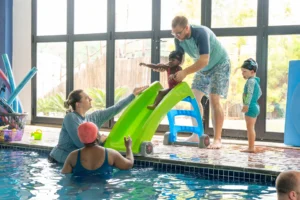
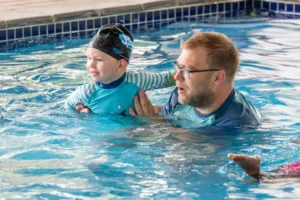
From around age two, Splash Tots starts to look different. Parents are still in the water — but they hold less. They prompt more. They step back when their child is ready to try something alone, even if only for a moment.
This is where you’ll start seeing:
- Independent back floats with short moments of unassisted balance
- Wall work — moving along the edge, holding on, finding safety
- Safe entries and exits — sitting on the edge, turning, climbing out
- Controlled jumping in — always toward the instructor, never on impulse
- Stronger breath control — blowing bubbles, breath holds, calm submersion
- Following the instructor’s lead rather than copying the parent
The parent is still the anchor — but they’re slowly handing the rope to the child. This stage prepares your toddler for the much bigger transition that comes at age three.
Age Three: The Move into Learn to Swim
This is the moment most parents quietly worry about: the first lesson without you in the water.
From age three, children move into Learn to Swim, and parents watch from the pool deck instead of holding their child in the water. It’s a real shift — for both of you — but it’s the shift every confident swimmer eventually makes.
At Splash Co, Learn to Swim runs across three structured levels, each one building on the last.
LTS Level 1 — Assisted
This is the first step out of Splash Tots and the first time the instructor — not the parent — guides the lesson directly. Lessons at this level focus on:
- Comfort and trust with the instructor in the absence of the parent
- Assisted floats (front and back) with hands-on support
- Wall confidence — holding on, moving along, climbing out
- Controlled submersion and calm breath holds
- Listening, following instructions, and routine
This level isn’t about how far the child can swim. It’s about transferring trust from parent to instructor and reinforcing every survival foundation that Splash Tots built.
LTS Level 2 — Semi-Assisted
Once the child is settled, listening well, and comfortable with the instructor, they progress to semi-assisted work. This is where movement really starts to look like swimming:
- Floats with reduced support — brief unassisted moments
- Kicking on a noodle or flotation aid with focus on rhythm
- Doggy paddle over short distances
- Front-to-back and back-to-front roll-overs
- Retrieving objects through controlled submersion
- Stronger, longer breath holds
This is also where a lot of parents start seeing the magic. Their child isn’t just “okay in water” — they’re actually moving through it.
LTS Level 3 — Unassisted
At Level 3, children swim without flotation aids and without hands-on assistance. The instructor is right there, but the child is doing the work. Skills include:
- Unassisted floats — front and back
- Unassisted short-distance swimming
- Confident entries, including jumping in and resurfacing calmly
- Refined breath control and timed breathing
- Strong, independent wall returns
When a child completes Level 3, they have what we consider the non-negotiable foundation: they can survive in water. From here, formal stroke development becomes the next chapter.
Why We Don’t Rush Into Strokes
Parents often ask when “real swimming” — proper strokes — begins. The honest answer is that strokes are only introduced once a child has completed LTS Level 3.
There’s a reason for this. Stroke development without a proper foundation builds technique on top of fear, or on top of poor body position, or on top of breath-holding habits that are hard to undo later. Children who progress through LTS first learn strokes faster, calmer, and with cleaner technique than children who are rushed into freestyle before they’re ready.
When exactly that happens depends on the child. Some progress through the three LTS levels quickly. Others take longer. Both are completely healthy — progression at Splash Co is based on skill, not age.
Signs Your Child Is Ready for the Next Step
Your instructor will always guide you on progression, but there are signs you can watch for at home:
- Calm in the bath, even with water on the face
- Willingness to try things independently
- Following simple instructions without resistance
- Reduced separation anxiety
- Excitement (not dread) before lessons
If you’d like a broader breakdown of when to start at each age, our earlier post covers it in detail: 👉 https://splashco.co.za/party-blog/what-is-the-best-age-for-swimming-lessons/
And if you’re just starting your child’s journey, our Splash Tots guide explains the foundation everything else is built on: 👉 https://splashco.co.za/swim-blog/baby-swimming-lessons-guide/
What Parents Can Do at Home
Lessons are most effective when they’re reinforced outside the pool. Children at this stage learn through repetition — and the more environments they practise in, the faster the skills generalise.
Simple things to keep doing at home:
- Bath time practice — gentle face dips, blowing bubbles, calm back floats
- Pouring water over the head to reinforce calm responses
- Talking about lessons positively — children absorb our tone, not just our words
- Avoiding “be careful!” warnings near the pool — replace them with calm, specific instructions
A child who is calm in the bath is almost always calm in the pool.
Why the First Few LTS Lessons Can Be Hard — and Why It’s Worth It
The first few Level 1 lessons without a parent in the water can be tough. Tears are normal. Reaching for you is normal. Wanting to go home is normal.
This is not a sign your child isn’t ready. It’s a sign they’re growing.
At Splash Co, this transition is handled gently:
- Parents stay visible, just not in the water
- Instructors build a personal relationship with each child
- Lessons stay structured and predictable — 25 minutes of learning, 5 minutes of play
- Routines are repeated so the child knows what to expect
Within a few weeks, most children settle completely. And the ones who push through this stage almost always become the strongest, calmest swimmers down the line.
Why an Indoor Heated Pool Still Matters at This Age
Toddlers and young learners are even more sensitive to temperature than babies. A cold pool causes:
- Tense muscles
- Shorter attention spans
- Faster fatigue
- Tears that have nothing to do with the actual lesson
A warm, indoor heated pool keeps children relaxed long enough to actually learn. It also means lessons happen year-round, which is essential at this stage — early swimming skills are built on consistency. A two-month winter break can undo months of progress.
Splash Tots and Learn to Swim in Randburg
If you’re looking for structured toddler swimming lessons Randburg or a proper Learn to Swim programme, the environment matters as much as the curriculum.
As a dedicated swimming school Randburg, Splash Co offers:
- Small, structured Splash Tots and LTS classes
- Clear stage-by-stage progression through three Learn to Swim levels
- Year-round lessons in a warm indoor pool
- A confidence-first approach to separation and independence
- 25 minutes of focused learning plus 5 minutes of play, every lesson
- Honest communication with parents about progress
Final Thoughts
The journey from Splash Tots to Learn to Swim is one of the most important transitions in your child’s water life. It’s where comfort becomes capability — and where survival skills become second nature.
I say this often, and I’ll say it again: swimming is a life skill, not a luxury.
If your child is already in Splash Tots, the foundation is being built every single week. If they’re approaching three, Learn to Swim is the natural next step. And if you’re joining us for the first time at this stage — that’s perfectly fine too. We meet every child where they are.
💦 To learn more about Splash Tots, Learn to Swim classes, or our swimming school in Randburg, visit splashco.co.za or contact Splash Co. We’ll walk you through every stage, one calm lesson at a time.
