
_______________________________________________________________________________________________
This is a conversation I have every single day with parents.
When is the right time to start baby swimming lessons?
What do babies actually learn?
Is it really necessary to start so young?
The honest answer is this: the earlier the exposure, the better the foundation. Not because babies need to swim independently, but because they need to understand water in a calm, positive, and structured way.
At Splash Co, baby swimming lessons are carefully designed to build baby water confidence, baby water safety, and survival awareness through fun, interaction, and repetition — always with a parent involved and always at the child’s pace.
Why Baby Swimming Lessons Look Different to Traditional Swimming
Before breaking things down by age, it’s important to understand one thing:
Swimming lessons for babies are not about strokes or distance.
They are about:
Orientation in water
Calm responses instead of panic
Understanding buoyancy and floating
Trust between child, parent, and instructor
Learning survival principles in a non-threatening way
Everything we do in baby swim classes is intentional. Skills are layered slowly so babies feel safe, engaged, and confident.
When to Start Baby Swimming Lessons
Most babies can start baby swimming lessons from around 6 months old, provided:
They have head control
They are comfortable being held
Lessons are structured and age-appropriate
This is widely regarded as the best age for baby swimming lessons because fear has not yet developed, making learning far more natural.
If you’d like a broader breakdown across all ages, we explain this in detail in our earlier post:
👉 https://splashco.co.za/party-blog/what-is-the-best-age-for-swimming-lessons/
What Babies Learn in Swimming Lessons (Stage by Stage)
6–12 Months — Orientation, Comfort & Trust
This stage is all about introducing water correctly.
At 6–12 months, babies are learning how water feels around their body and how to stay calm in it. Baby swimming lessons at this age focus on:
Orientation
Babies are gently moved through the water so they understand where they are in relation to their parent, the instructor, and the pool. Turning, positioning, and gentle movement help water feel familiar rather than overwhelming.
Supported Back Floats (Assisted & Unassisted Play)
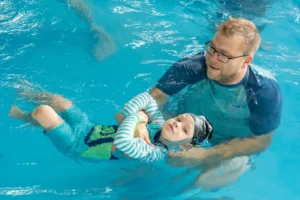
Back floating is introduced early as a key safety foundation. Initially, floats are fully assisted. As confidence grows, babies experience short moments of unassisted back floating through play, helping them understand buoyancy in a calm and positive way.
Controlled & Guided Submersion
Submersion is never forced. Babies are guided gently under the water using cues and timing. In some cases, babies are allowed to fall forward naturally, teaching them that going under water is temporary and safe.
Social Skills Through Group Songs
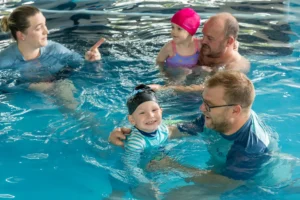
Group songs and routines are an important part of baby swim classes. They help babies:
Feel relaxed and familiar
Recognise routine
Begin early social interaction
Bonding With Parents
Parent and baby swimming is critical at this stage. Babies take emotional cues from their parents, and calm interaction builds trust and reinforces that water is a safe place.
Outcome:
Comfort, trust, and positive association with water — without fear.
12–24 Months — Confidence, Movement & Early Independence
This stage builds directly on what was learned between 6 and 12 months, but with less assistance and more independence.
Back Floats With Reduced Assistance
Children begin floating with less hands-on support, learning to balance their bodies while remaining closely supervised.
Crawling Along the Wall
Children are taught to move along the pool wall, helping them understand:
Where safety points are
How to reach the edge independently
How to support themselves in the water
Entries and Exits
Safe entries and exits are introduced so children learn how to get into and out of the pool calmly and correctly.
Orientation & Rotation
Children practise turning from front to back and back to front. Rotation teaches them how to reorient themselves if they lose balance.
Water in the Face
Gradual exposure to water on the face helps children remain calm rather than panic.
Unassisted Swimming (Short Distances)
Short, supervised unassisted movements are introduced to build confidence and awareness.
Outcome:
Early independence, calm responses, and growing confidence in water.
Irrespective of Age, Ability or Mobility — The Goal Remains the Same
Irrespective of age, ability, or mobility, the ultimate goal of baby swimming lessons is always the same:
Teaching children how to survive in water in a fun, interactive, and confidence-building way.
Survival skills are developed through:
Repetition
Familiarity
Positive exposure
Calm, guided learning
Fear-based teaching slows progress. Fun, interactive learning builds confidence — and confidence leads to better outcomes.
Why Practising at Home Matters
Swimming lessons don’t stop when the class ends.
Parents play a vital role by reinforcing what is learned during bath time routines and other safe water environments at home. This helps babies connect skills across different settings.
Simple examples include:
Gentle back floating in the bath
Allowing water to run calmly over the face
Repeating songs and cues used in class
Encouraging relaxed splashing and movement
When these skills are practised at home, babies learn faster because water behaves the same everywhere — not just in the pool.
Consistency Across All Water Environments
Applying the same principles in different water environments helps babies:
Build stronger baby water confidence
Respond calmly instead of panicking
Generalise skills rather than limit them to one space
This consistency is essential for long-term baby water safety.
Why an Indoor Heated Pool Matters
A warm, indoor heated pool is essential for effective baby swim classes.
It:
Keeps babies relaxed
Prevents cold shock
Allows year-round consistency
Creates a calm learning environment
Comfort leads to confidence, and confidence leads to progress.
Baby Swimming Lessons in Randburg
If you’re looking for baby swimming lessons Randburg, choosing the right environment matters.
As a dedicated swimming school Randburg, Splash Co focuses on:
Small, structured baby swim classes
Confidence-first teaching
Strong parent involvement
Clear progression pathways
Final Thoughts
I say this often because it’s important:
Swimming is a life skill, not a luxury.
Baby swimming lessons are not about rushing milestones — they’re about giving children the right foundation. When taught correctly, babies learn to respect water, remain calm, and enjoy being in it.
Whether you’re researching when to start baby swimming lessons, looking for trusted swimming lessons for babies, or searching for baby swimming lessons Randburg, the most important thing is starting in the right environment.
💦 To learn more about baby swimming lessons, parent and baby swimming, or baby swim classes, visit splashco.co.za or contact Splash Co. We’ll guide you properly, from the very first lesson.
